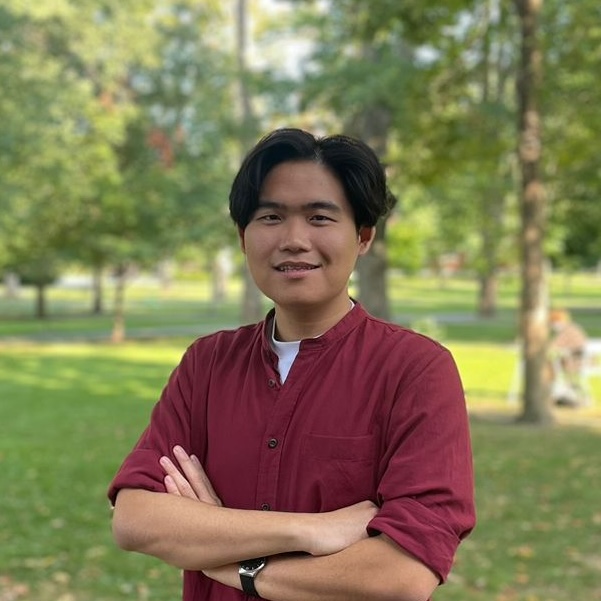
Richard F. M. Lim

Richard F. M. Lim林枫眠

Hi! I'm a final-year Mathematics and Computer Science undergraduate at Bowdoin College. I attended the Budapest Semesters in Mathematics and finished with honors. I study the geometry of generalization and representation in machine learning, with specific interests in length extrapolation for neural algorithmic reasoning and gradient-based interpolation for implicit neural representations. I use tools from tropical, polyhedral, and convex geometry.

News

Projects

Length-OOD Generalization and Transfer Learning Limits on Dynamic Programming Problems

NeurReps Workshop @ NeurIPS 2026

Advisor: Ruriko Yoshida, Ph.D.

Work done at the Naval Postgraduate School. Length generalization is a notoriously hard problem for neural networks. However, Tropical Attention, based in the tropical (max/min-plus) semiring, is a conspicuous exception, achieving strong length generalization on dynamic programming (DP) tasks. We ask what is required for length generalization on DPs. We demonstrate that embedding DPs as a tropical polynomial is lossy and does not respect the DP’s graph topology. Finally, we prove two negative results. The semiring’s two native ways to reduce dimension (setting a variable to each identity) are neither injective nor always closed within the DP. Series and parallel composition fail to construct all DAG topologies from smaller sub-DAGs, and even all terminal-only operations do not capture all DP compositions.

Clustered Mini-batching and Sampling Schemes for Stochastic Optimization

In preparation

Advisors: Jeová Farias, Ph.D., András Benczúr, Ph.D., Bálint Zoltán Daróczy, Ph.D.

In collaboration with the HUN-REN Institute for Computer Science and Control (SZTAKI) in Budapest, Hungary. A growing body of work focuses on aligning losses to the local analytic geometry of target functions (Rame et al., 2023, Zha et al. 2023, Zhu et al., 2025). However, uniform sampling and mini-batching assumes that the global geometry does not conflict with local geometry. We design k-Neighborhood Aware Sampling (k-NAS), a mini-batching scheme that builds localized mini-batches controlled by a softmax temperature hyperparameter. Preliminary results suggest moderate improvement on noisy reconstruction tasks for Implicit Neural Representations (INR).